
Gérald Genta and the birth of the Royal Oak
Updated: Jun 9
By Walty, Pre-owned Watch Specialist at Waltana, Lausanne · Updated May 2026
A Watch industry at a crossroads
The early 1970s were a turbulent time for Swiss watchmaking. The industry was on the eve of the quartz crisis — a technological disruption that would soon shake the very foundations of traditional horology. At the same time, a cultural revolution was underway, blurring the lines between formality and casual living, between sportswear and elegance.
The gap between sports and evening watches looked insurmountable, but the ongoing cultural revolution tended towards abolishing such distinctions across the board. It is at this point that the concept of the Royal Oak took seed: a watch as sporty as it is elegant, adapted to modern lifestyles.
Audemars Piguet, a small but prestigious manufacture nestled in the Vallée de Joux, saw an opportunity to do something radical — to create a luxury watch that could be worn anywhere, by anyone living an active, modern life. The challenge they set themselves was audacious: build the world's first high-end sports watch, not in gold or platinum, but in stainless steel.
One night, one genius
To realise this vision, Audemars Piguet turned to one of the most celebrated watch designers of his generation: Gérald Genta. The commission came at the last minute — the night before the Basel watch fair in 1971 — with a brief as demanding as the deadline was tight. Genta had to design something entirely new, something that had never been done before, overnight.
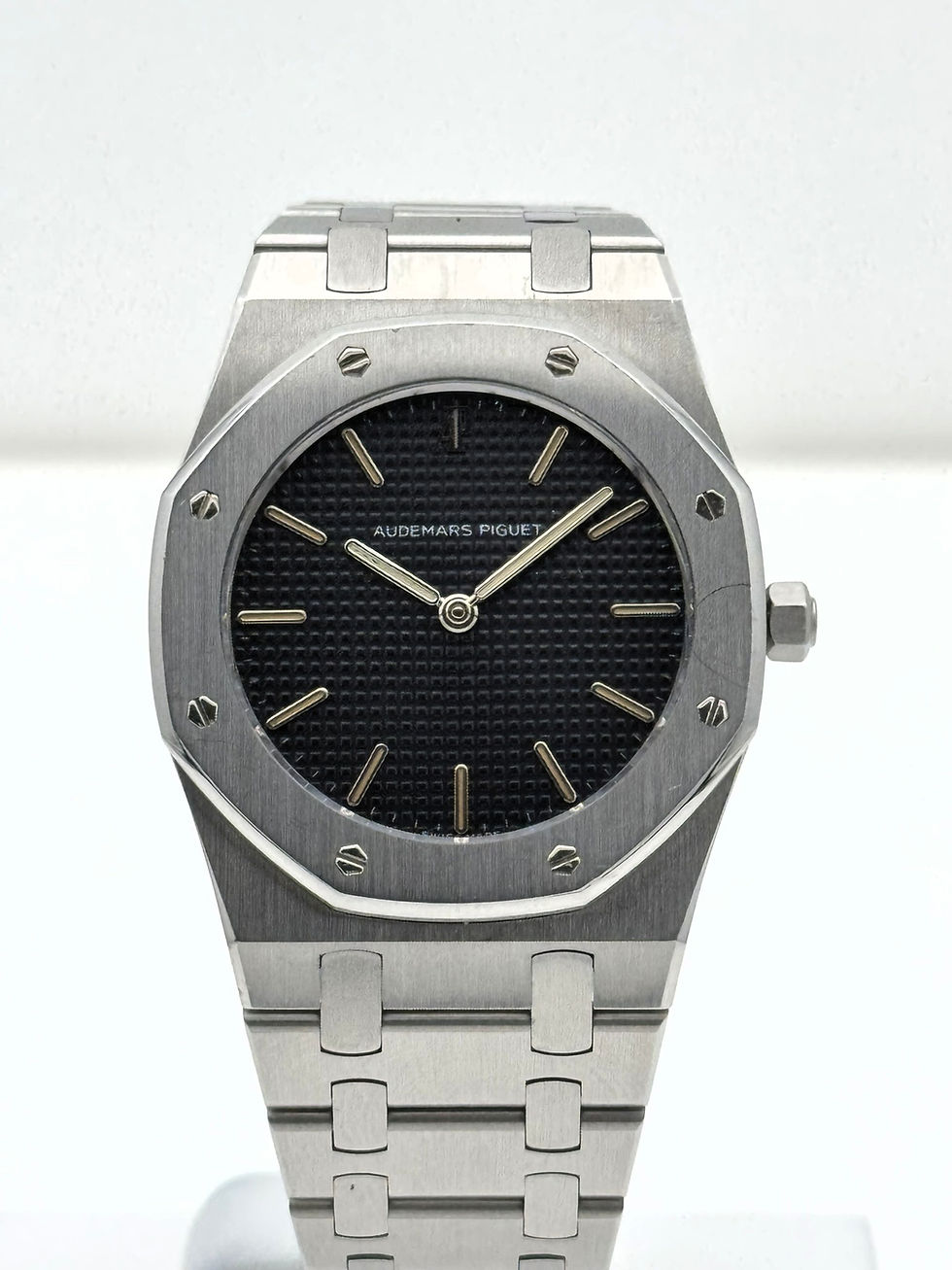
He delivered. Drawing inspiration from the helmet worn by deep-sea divers, Genta sketched an octagonal bezel secured with eight exposed hexagonal screws — a bold, industrial touch that was utterly unlike anything in fine watchmaking at the time. Its large body of hand-finished stainless steel, its octagonal bezel secured with visible hexagonal screws, its integrated steel bracelet and its extra-thin selfwinding mechanism created a stir.
The disruptive lines, sketched in one night by Gérald Genta, proved so successful that they established a recognisable look for the next five decades.
The movement inside was equally remarkable. The case was entirely hand finished and housed the thinnest selfwinding movement with date indication of its time — Calibre 2121. Steel had never been elevated to such a status in haute horlogerie. The Royal Oak didn't just look different — it redefined what a luxury watch could be.
From iconoclast to icon
Since its groundbreaking debut in 1972, the Royal Oak has stood as a symbol of audacity and innovation in the world of Haute Horlogerie, blending technological advances with ancestral craftsmanship. The original reference — the 5402, often nicknamed the "Jumbo" for what was then considered its oversized 39 mm diameter — was initially met with scepticism. Retailers were unconvinced by a steel watch priced above gold equivalents.
Time, however, proved the doubters wrong.
The unique Royal Oak steel model had given rise to a whole collection. By 1976, Audemars Piguet had introduced the first women's Royal Oak, designed by Jacqueline Dimier, reducing the case to 29 mm. By 1977, gold and two-tone versions entered the catalogue. Between 1977 and 1981, more than 27 new references were born across sizes, complications, and materials.
In 1993, the Royal Oak Offshore pushed the concept further still — a 42 mm chronograph that pioneered oversized sports watches and inspired a generation. In 2022, Audemars Piguet unveiled its latest research and development breakthrough with the Royal Oak Selfwinding Flying Tourbillon Extra-Thin to celebrate the iconic collection's jubilee.
Today, with more than 500 iterations created, the Royal Oak has become an icon within and beyond watchmaking, embodying Audemars Piguet's free and avant-garde spirit. Genta would go on to design other legendary timepieces — the Patek Philippe Nautilus, the IWC Ingenieur — but it is the Royal Oak that remains his most enduring contribution to the art of watchmaking.
A single sleepless night in 1971 gave the world a watch that still turns heads more than fifty years later.
The full story of the Royal Oak's creation and its impact on the industry is covered in our dedicated article on Gérald Genta and the birth of the Royal Oak.


